Thinking about diversifying your farm? Six questions to ask before you invest
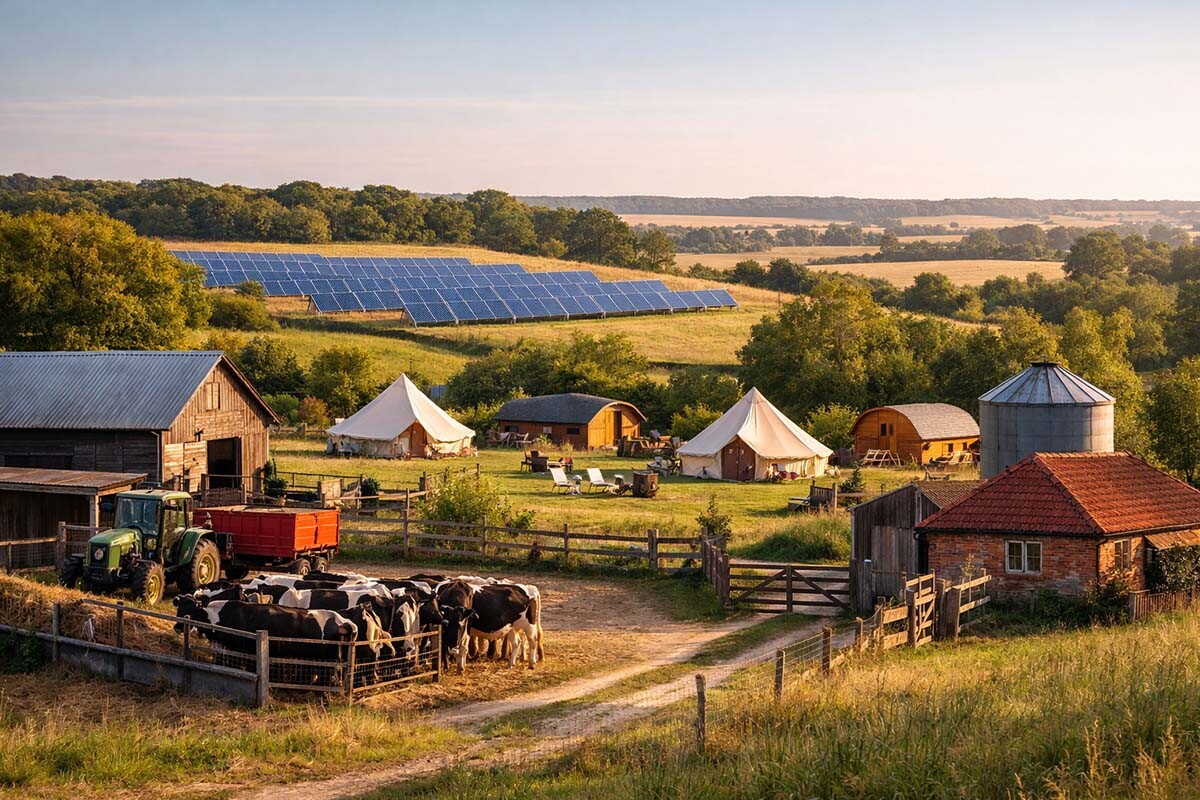
Diversification can create valuable new income streams, but the best ideas aren’t always the biggest or most complicated. This article walks through six areas to sense-check before you commit your time, money and energy: the idea, the money, the practicalities, your customer, getting found and the wider farm business. It finishes with four tests to tell you whether the idea is right for you.

Rural Diversification Insights from Smart Wave Business Support
28 October 2026
How to sense- check a Farm Diversification idea before you spend anything
Diversification can bring in valuable new income, but the best ideas aren’t necessarily the biggest or the most complicated. A few well-planned self-storage barns can outperform an ambitious venture that stretches your time, money and patience too far. Before you invest in anything, it pays to work through the questions that really matter. Here are six areas to sense-check, followed by one final test that’s easy to overlook.
1. The idea
Start with demand. What problem does your idea solve, who is going to pay for it, and what makes it different from what’s already on offer nearby? Then be honest about fit. Does it suit your land, your skills and your lifestyle, and does it complement what you already do? If you can, test it before committing to a major investment. A pop-up, a small trial or a handful of pre-bookings will tell you far more than a hunch will.
2. The money
Work out what it will cost to get started and what it will cost to keep going. Then ask how much you realistically need to earn from it, and how many customers, bookings or sales that means. Rural businesses can be seasonal, so allow for quiet periods rather than assuming a steady flow or choose an enterprise that is all year round. Finally, estimate how long it will take to recover your initial investment. If the answer makes you wince, it’s far better to know now than later.
3. The practicalities
This is where promising ideas often stall. Check whether you need planning permission or other consents and speak to your local planning authority early. Think about access and parking, water, power, drainage and waste. Consider insurance and health and safety, particularly if members of the public will be on site. Then list the equipment, buildings or infrastructure you’ll need, and decide who is actually going to run it day to day.
4. Know your customer
Picture your ideal customer. What are they looking for, and why would they choose you rather than somewhere else? Think about their whole experience, from first enquiry to the moment they leave, and how you’ll encourage repeat visits and recommendations. For many rural businesses, word of mouth is the most valuable marketing there is, but it only works if the experience is worth talking about.
5. Getting found
A great offer is no use if nobody can find it. Do you have a clear name and proposition? Is your website doing its job, and can people find you on Google? Good photography or video makes a big difference, and social media should be working for you rather than eating your time. A simple way to capture customer emails and a plan for generating enquiries and bookings will help you keep the diary full. A reputable review site is invaluable for any business, not only will this help your SEO but give customers reassurance.
6. The farm business
Finally, look at the bigger picture. Does this support the long-term future of the business, and will it sit comfortably alongside your existing farming? Consider the skills you already have, what you can realistically manage yourself and what could be outsourced. Decide now what success would look like in 12 months, so you can plan to upscale if necessary.
Now take a step back
Once you’ve worked through the checklist, ask whether this diversification is right for you. Four simple tests help. Is it commercial: will it make a worthwhile contribution? Is it practical: can you actually deliver it? Is it customer-led: will people pay for it? And is it personal: will you still want to be doing it in five years?
If you have more questions than answers, that’s fine. That’s usually where the interesting work starts. A good idea still needs a good plan, so don’t just ask “Could we do it?” Ask “Should we do it, and what would make it work?”
Smart Wave Business Support helps farmers, rural businesses and diversified farms turn ideas into practical plans, then create the visibility you need to bring in the customers and make the idea a success. It may well be that an initial conversation with me then leads to a relationship with specialist planning agency and then back to me for the execution of the marketing to bring the project to life.
Written by Ally Mitchell
Founder, Smart Wave Business Support
Discover more and get in touch with Smart Wave Business Support
Could your expertise support landowners exploring rural diversification? Join the rural diversification supplier directory
Explore more insights from the Rural Diversification Collective
Nixon Heritage & Design
Can I convert a listed building for farm diversification?
Exdell Limited
How can I find out what my land could really be worth?
Jonny Bann Consultancy
How can I fill midweek gaps at my venue with corporate bookings?
Jonny Bann Consultancy
How can I make better use of my venue’s existing assets for the corporate market?
SPASE Architects & Surveyors
How energy retrofit can make a heritage building work as a rural business
Dudley Peverill Associates LLP